

Governance Bingo: The Words You'll Hear in Every MDT Meeting
You know the meeting. Ten minutes in, someone says "going forward" and you feel it — the low hum of a hundred meetings just like this one, stretching back through your entire career.
We thought it was time someone wrote the bingo card.
The card
Print it, screenshot it, tape it under the boardroom table. Five across, five down, one free square in the middle for whoever brought biscuits.
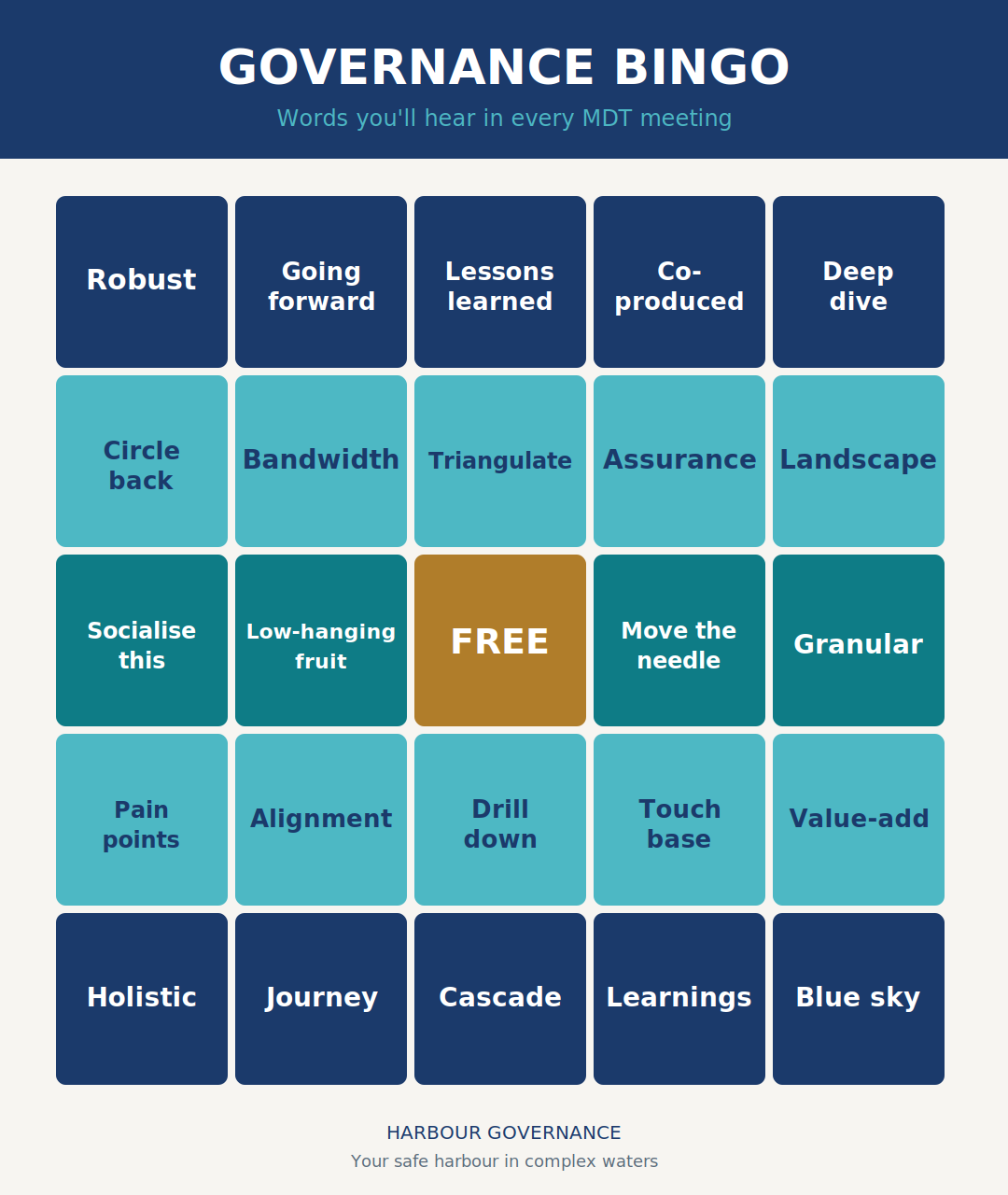
Commonly Used Words in Governance Meetings.
Full house gets you nothing except the quiet satisfaction of having survived the meeting with your sense of humour intact.
Why we all talk like this
Here's the less funny bit, and it's worth two minutes of your day.
Jargon in governance meetings isn't just habit. It does actual work — some of it useful, most of it not.
The useful part: shorthand saves time between people who already share the same reference points. "Triangulate the data" means something specific to a room full of quality leads who've done it a hundred times. Said to a new starter, or worse, to a patient or family member, it means nothing at all.
The less useful part is what "robust" is really doing in most sentences. It's rarely describing anything. It's filling the space where a specific claim should be — the actual staffing ratio, the actual audit frequency, the actual number of incidents reviewed last quarter. "We have a robust incident reporting process" tells an inspector nothing. "We reviewed 94% of incidents within five working days last quarter, against a target of 90%" tells them everything.
That's the real cost. Not that jargon is annoying — though it is — but that vague language lets vague thinking hide in plain sight. A policy document full of "comprehensive frameworks" and "ongoing assurance" can sail through several review cycles without anyone checking whether it actually says anything. Precise language forces precise thinking, because you can't write a specific number or a specific date without first knowing it.
CQC inspectors have heard "we take a holistic approach" more times than any of us have. What lands, every time, is the plain sentence: what happened, what you did about it, what changed as a result.
A small challenge for your next document
Before you next write "robust," stop and ask what number, date, or named person would actually prove the point. Nine times out of ten, that's the sentence you meant to write.
Full marks if you get through the next MDT without needing your bingo card at all.
We'll believe it when we see it.
